Détails du livre

Téléversé par : Isaac NDJENG
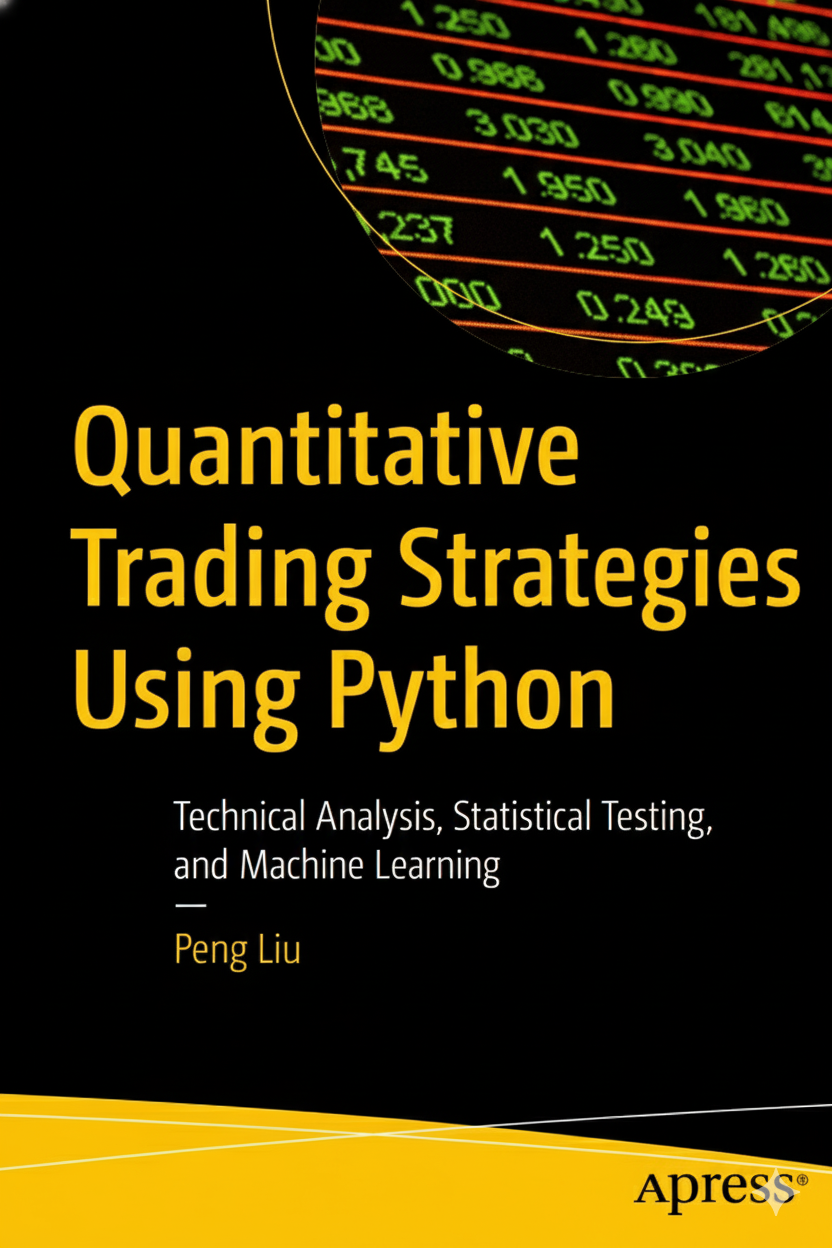
Collection : Quantitative Trading Strategies Using Python: Technical Analysis, Statistical Testing, And Machine Learning
Date de mise à jour : Sat, 20-Dec-2025
Nom de la catégorie : Technologie & Informatique
Book Title: Quantitative Trading Strategies Using Python: Technical Analysis, Statistical Testing, And Machine Learning
Author: Peng Liu
Publisher: Apress (Springer Nature) – 2023, Singapore
Language: English
Access: Official resale rights held by Big Data Consult, with lifetime access via www.bigdataconsult.fr
Peng Liu is a practitioner specializing in Quantitative Trading, combining finance, data analysis, statistical testing, and Machine Learning to develop automated trading strategies.
His work bridges financial theory with practical, code-based applications using Python.
The book provides a hands-on, Python-centered guide for designing, testing, and evaluating quantitative trading strategies using three pillars:
Technical Analysis – Indicators and trading signals.
Statistical Testing – Performance evaluation and risk management.
Machine Learning – Predictive modeling for market data.
The emphasis is on practical application to common financial instruments such as stocks and ETFs.
Core Topics Covered:
Trading and Python Fundamentals: Introduction to financial markets, trading lifecycle, and Python libraries (pandas, numpy) for data analysis and market access.
Technical Analysis (Pillar 1): Implementation of classic indicators (Moving Averages, RSI, MACD) in Python, transforming signals into actionable strategies like Mean Reversion or Trend Following.
Statistical Testing & Backtesting (Pillar 2): Rigorous evaluation of strategies using:
Historical simulation
Risk-adjusted performance metrics (Sharpe Ratio, Max Drawdown)
Statistical significance testing
Bias control (Look-ahead, Survivorship)
Machine Learning for Trading (Pillar 3): Enhancing strategies with ML:
Supervised models (Logistic Regression, SVM) for price direction prediction
Unsupervised learning (clustering) to identify market regimes
Time series and deep learning (RNN/LSTM) for sequential forecasting
Risk and Capital Management: Position sizing, stop-loss, trailing stops, and capital allocation for real-market robustness.
Python Developers & Data Scientists: Applying coding skills to quantitative finance.
Individual Traders: Automating and professionalizing trading strategies.
Students & Researchers: In computational finance, applied mathematics, or financial engineering.
Financial Analysts: Integrating Machine Learning into their analysis workflow.
All-in-One Guide: Combines Technical Analysis, Statistical Testing, and ML in one resource.
Python Skills in Action: Directly applicable for backtesting and automated trading.
Statistical Discipline: Teaches robust validation to distinguish real performance from luck.
Competitive Edge with ML: Applies ML to extract sophisticated signals beyond traditional indicators.
Quantitative Trading Strategies Using Python equips readers to move from intuition-driven trading to systematic, data-driven, and reproducible strategies.
It delivers the methodology, tools, and Python implementations for designing, validating, and managing trading strategies with real-market resilience.
Big Data Consult holds the authorized resale rights for this publication.
All students purchasing through our platform gain lifetime access to the full book content and resources via www.bigdataconsult.fr.
| Titre | Algorithmic Trading Made Practical: Python, Statistics, and Machine Learning for Traders | |
|---|---|---|
| Producteur du contenu | Isaac NDJENG | |
| Collection | Quantitative Trading Strategies Using Python: Technical Analysis, Statistical Testing, And Machine Learning | |
| Edition : | Apress (Springer Nature) – 2023, Singapore | |
| Nombre de page | 341 | |
3500 FCFA

Isaac NDJENG est le fondateur de BIG DATA CONSULT, expert en reporting financier et Business Intelligence. Fort de son expérience dans les BIG 4 et certifié en Business Analytics, il accompagne les entreprises dans la valorisation de leurs données et la montée en compétences digitales en Afrique francophone.


Étudiez n'importe quel sujet, à tout moment. Explorez des milliers de cours au prix le plus bas de tous les temps !